Two ceremonies, one weekend, three years of work.
May 11, 2026 · Field Notes
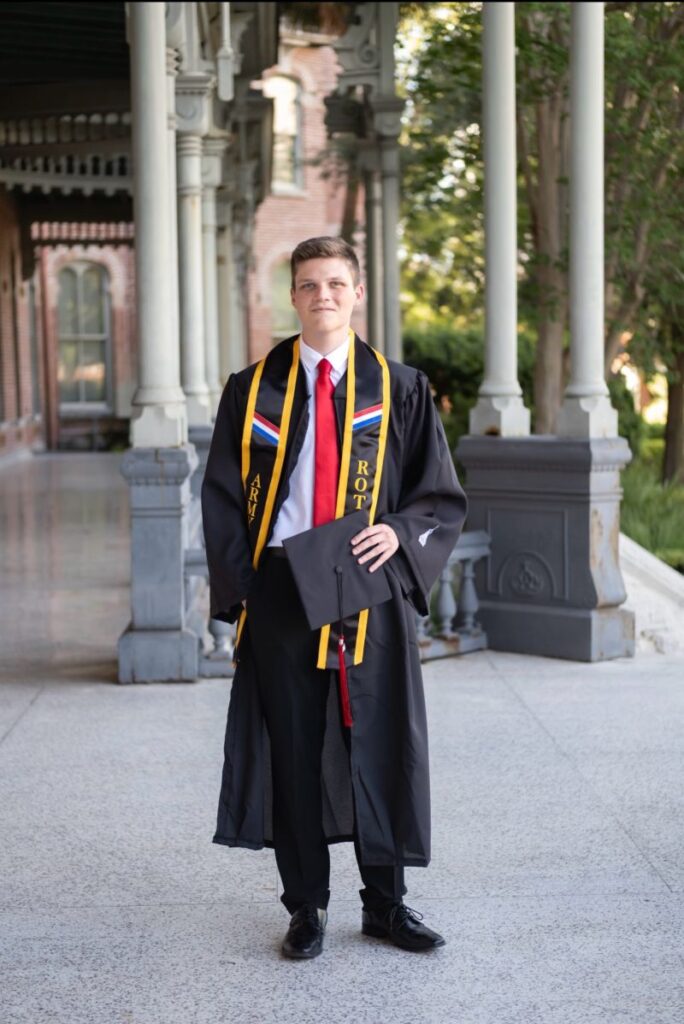
I graduated from the University of Tampa with a B.S. in Cybersecurity and commissioned as a Second Lieutenant in the U.S. Army National Guard, branched 17A, Cyber Warfare. Both happened inside the same 48 hours, which felt about right. They were always tied together.
The shorter version
Started at Tarrant County College in 2020. A.A. General Studies, two and change years, didn’t know what I wanted yet. Transferred to UTampa in 2023 to do cybersecurity properly. Joined Air Force ROTC the same semester. A year later, I signed a contract with the Army and transitioned between branches. The next two years were a single overlapping arc: NSA CAE-CD coursework, research, the IT department at UTampa, ROTC PT at 0530 and ROTC labs in the afternoon, Basic Camp at Fort Knox the summer of 2024, Advanced Camp the summer of 2025, AFIT internship at Wright-Patterson that same summer, and then a final senior year that included a 24×7 NOC job at Tampa Electric starting in January.
It was, in retrospect, a lot.
Why 17A
I get this question often, so: I picked Cyber for the obvious reason that it’s what I do, and I picked the National Guard for the less obvious reason that I wanted to keep both feet in the civilian sector too.
Active duty would have meant going wherever the Army sent me, doing whatever the Army needed, and watching the commercial cyber industry move at its current absurd pace from the outside. Guard duty lets me drill in a cyber unit doing real mission work, defensive and offensive cyberspace operations support, while my day-to-day stays in the commercial world and on my own infrastructure.
The two halves feed each other. Things I see in the NOC inform how I think about military networks. Things I learn at drill inform how I think about adversary tradecraft on civilian ones. The skill transfer goes both ways, and I’d rather be fluent in both languages than master one and ignore the other.
What ROTC actually taught me
Less than people think about cyber. More than people think about everything else.
Leadership is mostly about making decisions with incomplete information while people are watching you and judging. Operations planning is the art of writing down what you’re going to do, then revising it the moment reality contacts your plan. PT teaches you that the body adapts to whatever you make it do, which generalizes uncomfortably well to studying for certifications, learning new tooling, and pulling an all-nighter before an 0400 8-mile ruck.
The technical skills I built in the cyber program. The decision-making muscle I built in ROTC. I needed both. The military pays for technicians but it commissions officers, and the difference between the two is the second skill.
What’s next
Drilling with my unit. Working at TECO. Pursuing an M.S. in Computer Engineering with a security focus at FIU online while I do it. TS/SCI is in adjudication. The clearance and the commission together open doors that neither one would open alone, and a lot of those doors are the ones I’ve been knocking on for six months in a federal/defense job search that has been… educational.
But that’s the next post.
Thank you to
Dr. Giovannetti for taking me on as a research assistant and trusting me with work above my pay grade. The ROTC cadre for putting up with the fact that I was simultaneously trying to be a full-time student, a part-time IT analyst, a full-time cadet, and a part-time scam investigator, and for not making me pick. My family for not asking too many questions about why I needed to be at Fort Knox for two summers in a row. And the AFIT cohort and ITS, which gave me people to think alongside, which turns out to be the thing that matters most.
On to the next one.